We’re excited to share that Reverge 1.2.0 is out. This release includes a major architectural change under the hood: the AI assistant is now powered by Goose, the open-source agent framework from Block (formerly Square). This is a big step forward for automation, extensibility, and the long-term direction of AI-assisted recon in Reverge.
Why We Switched to Goose
The previous releases used agentscope to drive AI-assisted workflows. While it served its purpose, we began looking for a platform that offered stronger long-term extensibility, active development, and deeper alignment with emerging standards for agent tooling.
That led us to Goose, an open-source agentic framework maintained by Block and already used by thousands of engineers internally. Goose is designed to manage many of the complexities of agent systems out of the box. This includes context window management, token usage, and performance considerations, which enables us to focus more on capabilities rather than orchestration.
Goose is built around the Model Context Protocol (MCP), the emerging standard for giving AI agents structured access to tools. Instead of treating tool integrations as an add-on, Goose makes MCP extensions a first-class concept. This allows us to expose Reverge capabilities directly as MCP tools, which Goose can automatically discover, invoke, and chain together autonomously without requiring custom orchestration code.
How It Works
The new architecture is intentionally simple. When you open the AI panel in Reverge, a Goose agent is already running on the same host. Reverge creates a dedicated session for each conversation and connects it to the Reverge toolset.
These tools expose Reverge’s capabilities: searching targets, exploring scan results, enumerating hosts and ports, scheduling scans, and more. Each AI session operates securely with short-lived credentials tied to the authenticated user.
Goose is also integrated directly into each collector through separate MCP servers. This allows the agent to interact with the collector environment itself, including reading and writing files, inspecting scan data on disk, and executing commands when necessary. By exposing these capabilities through MCP, Goose can safely interact with the underlying collector infrastructure to execute manual workflows.
When you ask a question, Goose determines which tools it needs, calls them autonomously, and iterates on the results until it has a complete answer. Instead of manually running multiple tools and stitching together outputs, you can simply describe what you want to learn about a target and let Goose handle the workflow.
Session Tracking
One limitation in previous builds was that AI sessions were stored in the browser’s local storage. That meant conversations were tied to a single browser instance and you could only have one active session at a time.
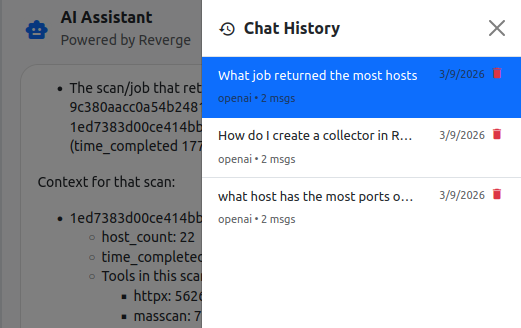
Starting in this release, sessions are now backed by the database. This allows you to run multiple AI sessions simultaneously and access them consistently from any connection or browser.
When a session is resumed, Goose receives the full conversation history through a dedicated MCP tool and continues exactly where the previous interaction left off. This also makes it possible to reference earlier sessions, build on previous analysis, and maintain continuity throughout an engagement.
AI Skills
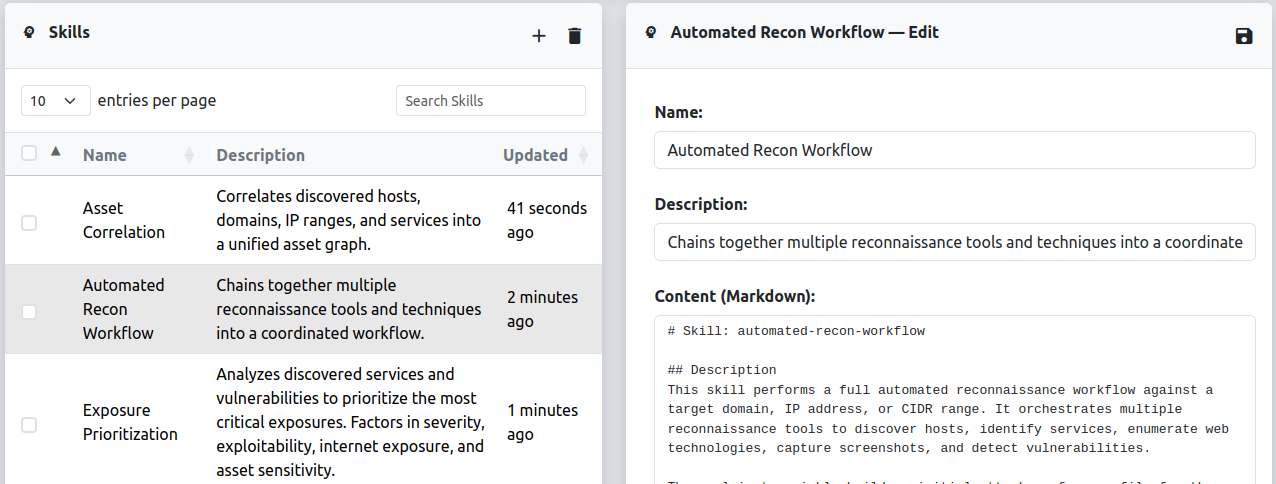
Also new in 1.2.0 is the AI Skills system. Skills are user-defined markdown documents that describe a specific workflow or approach — reusable agent playbooks that Goose can invoke when the task matches.
This is useful for encoding your team's recon methodology. How do you approach attack surface mapping? What do you check first on a new engagement? How do you correlate port data with known vulnerabilities? All of that can be captured as a skill. Skills are stored per-user in the database and injected into every session's instructions at startup, so Goose knows about them before the first message arrives.
Think of it as teaching the agent your playbook once so you don't have to re-explain it every time.
Flexible AI Provider Support
Goose supports multiple AI providers natively and Reverge exposes all of them. In 1.2.0 you can run the AI panel against OpenAI, Anthropic, Google Gemini, Ollama, or Snowflake Cortex — switchable at runtime with no restart required.
Running air-gapped or want to keep everything on-prem? Point Reverge at a local Ollama instance. Want the latest frontier model for complex multi-step analysis? Swap to Anthropic Claude or OpenAI. Running on Snowflake? Reverge supports Snowflake Cortex natively — configure your account host and Personal Access Token in settings and Goose will route through Cortex. The session adapts and the new provider is live on the next message.
Interact.sh Integration
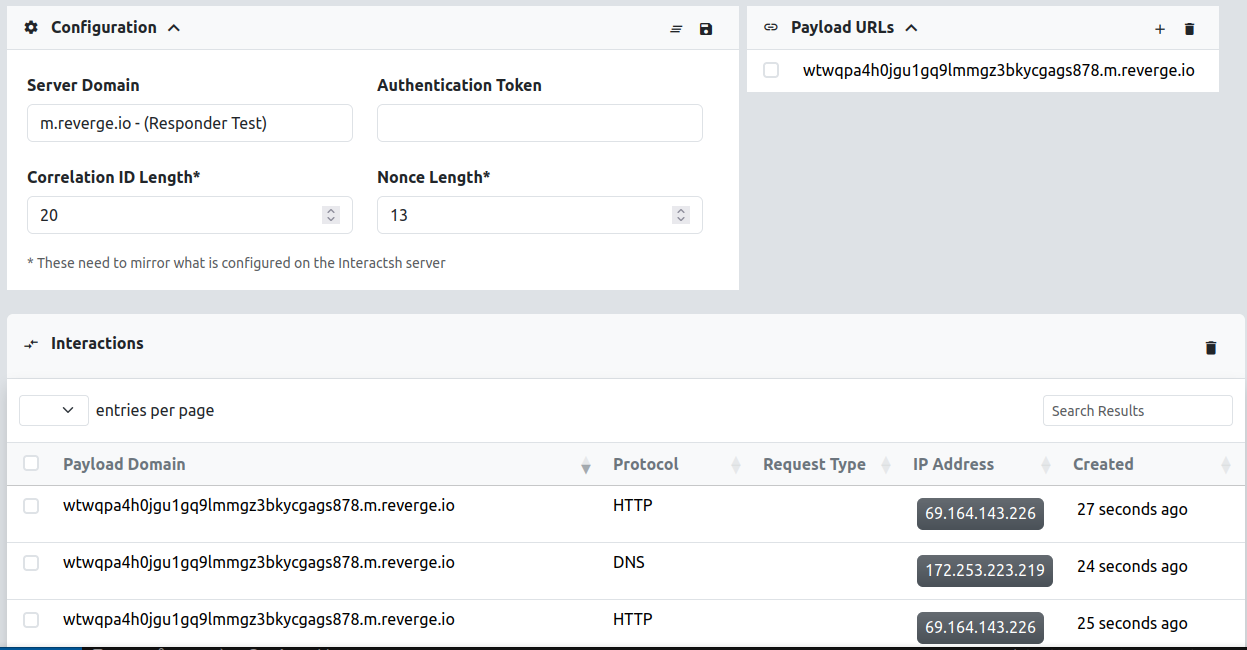
Reverge 1.2.0 adds a native interact.sh integration for out-of-band (OOB) interaction tracking. Interact.sh is an open-source OOB server that assigns unique callback URLs. Any DNS, HTTP, or SMTP interaction with those URLs is captured and correlated back to your payloads in real time.
The integration lives under Settings → Integrations → Interact.sh. Point Reverge at your own interact.sh server by entering the server domain and an optional authentication token. Once configured, Reverge registers with the server, generates payload URLs, and a background poller continuously pulls incoming interaction events and surfaces them in the UI, giving you a live feed of DNS callbacks, HTTP hits, and SMTP interactions tied back to your engagement.
Responder Collector — Self-Hosted interact.sh
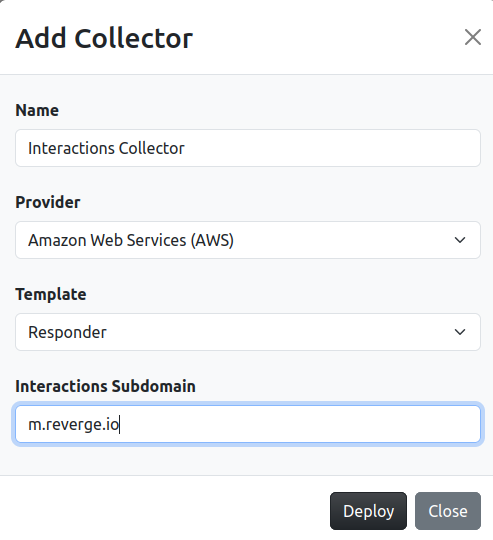
If you'd rather run everything under your own infrastructure, Reverge 1.2.0 introduces the Responder collector type. Deploying a Responder collector provisions a cloud VM via Terraform (AWS or DigitalOcean), automatically installs and configures an interact.sh server on it, and wires up DNS delegation so your chosen subdomain routes all callbacks to that host.
Setup is handled from the Collectors page: choose Responder as the template, enter the interactions subdomain you want to delegate, select a DNS provider (AWS Route 53 or Njalla), and deploy. Terraform provisions the VM, runs the interactions install script, brings up the interact.sh server as a system service, and configures DNS automatically. The result is a fully self-contained OOB listener that Reverge can poll for callbacks, no third-party OOB service required.
New Collector Modules: Netexec and IP THC
Two new scanning modules ship with the collector in this release:
Netexec adds protocol enumeration to the active scan chain. It runs against discovered open ports and performs targeted scanning across SMB, RDP, WinRM, LDAP, SSH, FTP, NFS, WMI, MySQL, and VNC, automatically selecting the right protocol for each port. Results include host details, service banners, and credential validation output, all imported back into Reverge's data model.
IP THC is a passive DNS intelligence module for reverse IP lookups and subdomain enumeration using the IP THC threat-intelligence platform. Given a set of target IP addresses, it queries the IP THC API for current and historical DNS records, surfacing domains resolving to those IPs, subdomain relationships, and WHOIS data. It runs passively with no direct traffic to target systems, making it a clean enrichment step before active scanning begins.
Looking Forward
The Goose migration is foundational. With MCP as the integration layer between the agent and Reverge's tools, adding new capabilities means writing a new MCP tool function, that's it. Over the next few releases we're planning to expand the tool set, deepen the Skills system, and explore multi-agent and parallel workflows for larger-scale engagement automation.
If you're interested in using Reverge and have questions, send us an email at contact[at]securifera.com.